dbt in 2026: Core, Cloud, and the Mesh Decision
1. Problem
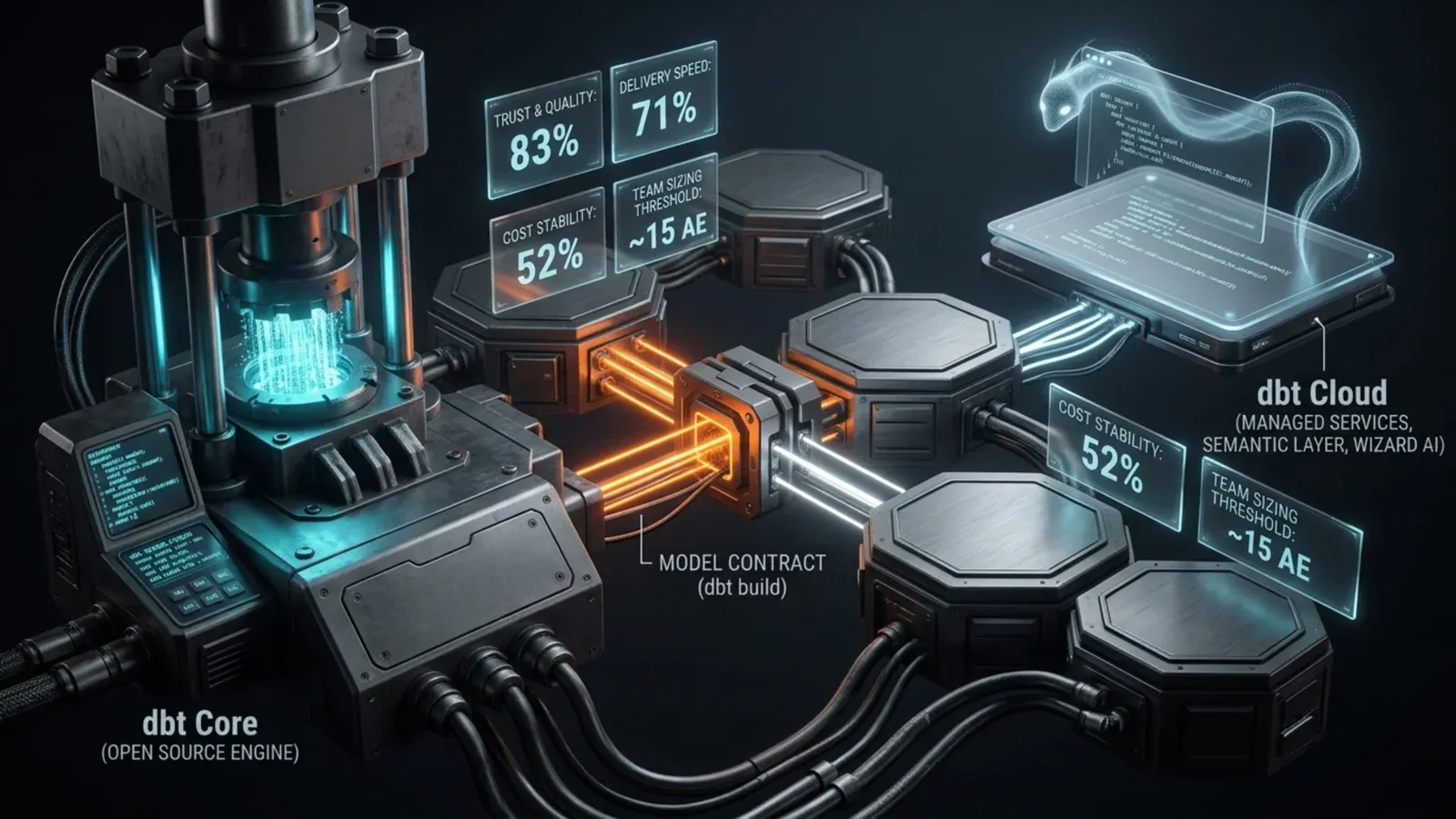
Every data platform that reaches multiple teams hits the same wall: the transformation layer grows into an unmaintainable monolith. Models are duplicated, ownership blurs, and one change in a shared table breaks three dashboards that no one can name. The classic failure is the “big ball of models”: a single dbt project with hundreds of SQL models, one team owning the repo, and every other team waiting in a queue. The 2026 State of Analytics Engineering report, the largest industry survey from dbt Labs, measured the underlying shift: trust in data and data teams rose to 83% priority and speed of delivery to 71%, both accelerating faster than any other objective, while cost stability is now in the top three for 52%.
This is the context where the real decision happens. Not “which SQL framework”, but where do you run the transform layer, and when do you split it.
2. Context
The tooling is now two products with a clear split. dbt Core is the open-source transform engine: models, tests, sources, and the dbt run CLI that turns SQL and data tests into a query DAG. dbt Cloud adds a managed editor, scheduler, observability, the Semantic Layer that exposes metrics, and the “dbt Wizard” agent released in 2026 that proposes model content and runs checks in the CLI loop. Core supports the same model syntax and is free, but requires you to operate observability, scheduling, and CI/CD yourself.
The practical boundary is sizing. Pragmatic field reports from 2026 consulting practices converge: teams below roughly 15 analytics engineers are better off running dbt Core plus an existing orchestrator (Airflow, Dagster, Prefect) because the operational cost of Core is small and the existing scheduler already runs their jobs. Above roughly 15 engineers, Cloud’s managed scheduler, observability and Semantic Layer justify the per-seat cost. dbt Mesh, which fuses multiple dbt projects into a cross-project DAG with explicit contracts (YAML model contracts, versioned model groups, cross-project references), is only worth it above ~25-30 engineers split across 2-3 teams; below that production Mesh is overhead.
3. Trade-offs
| Option | Control | Governance ceiling | Cost model | CI/CD effort |
|---|---|---|---|---|
| dbt Core + Airflow/Dagster | Full - runs on your infra | Single project, one repo | Free (runtime infra only) | Jacob orchestrator already does it |
| dbt Cloud | Vendor-runtime | Single project, managed observability + Semantic Layer | Per-seat subscription | Built-in |
| dbt Mesh (Core or Cloud) | Full + contracts | Multi-project, cross-team contracts | Added complexity + (Cloud seats) | Increases with cross-project tests |
4. Decision
For a self-hosted engineering team, the 2026 recommendation in three steps:
- Start with dbt Core on your existing orchestrator. Until you approach 15 analytics engineers, the infrastructure already runs jobs; Core adds models and tests without adding a second control plane.
- Adopt quality gates in CI as a first step, not an afterthought. The report’s finding - trust (83%) and speed (71%) are the top priorities for 2026, above cost (48%) - is the roadmap: define model tests (
dbt test), source freshness, contract tests on public models, and a--fail-fastCI gate. - Involve Mesh only when the DAG boundaries appear. When two teams start editing one project and code review turns into arbiter of a global namespace, that is when you split the project and publish access contracts via Mesh. Below that, one project with
selectorsandvarsis simpler than the full federation.
Contract-as-code
The structure that stabilizes the Mesh decision is the model contract. version: 2 contracts declare required columns and types; dbt build enforces them at compile time, not just in tests. This is the same discipline the design-firm uses for cross-team APIs. Before Mesh, make contracts mandatory on any model marked published.
The runtime split
Keep the orchestrator as the sole scheduler; dbt stays a step in the DAG. Airflow/Dagster/Prefect trigger dbt run --selector production and handle retries and SLAs. You avoid the Cloud scheduler dependency at the 15-15 matrix only when you want the Semantic Layer or managed observability - and the Wizard shows the AI pair-programming direction the vendor is pushing, which matters for the platform’s future, not the current core.
5. Result
With Core + CI + contracts, a 12-engineer team runs 3-6k rows of tests, with zero Cloud seat, in a DAG that still fits a single project. When the second team starts and change conflicts rise, the --contract + Mesh split lands in a weekend of mechanical work - because the disciplined core already separated models into layers and marked the shared ones public.
The resources list stays small: models are SQL tests in YAML, runtime is a container. The report’s 2026 signal - teams shipping faster via AI-assisted codegen while governance lags - matches the model itself: dbt is the winner of the “code correctness” workflow because tests and contracts are the governance. If you’re designing the data layer from scratch, read the dlt loading pipeline post for the ingestion side of the same stack, or the sovereign warehouse case study for the full platform shape.
Related Reading
- PostgreSQL Connection Pool Math: Preventing CascadesAn SRE postmortem and architectural deep-dive into how Kubernetes HPA and uncoordinated client-side connection pools trigger catastrophic PostgreSQL saturation.SREArchitectureObservabilityData Platforms
- High-Concurrency Remittance Infrastructure with Audit ControlsReal-time remittance core on CIS-hardened Debian with Fastify, PostgreSQL, and centralized audit logging.ArchitectureSecurityFinOpsNetworkingData Platforms
- Operative-Prime: Async AI and HITL Orchestration BackendAsync AI orchestration backend with FastAPI and hexagonal architecture: human-in-the-loop approval tokens, Valkey-based TTL enforcement, PostgreSQL, and auditAutomationArchitectureAI & LLMsDockerData Platforms
Have a specific infrastructure problem? Let's talk.
Start a Conversation